Why Capitalism Can't Survive AI, Part 4: Only One Door Left
A four-part series on the coming economic crisis and the only way through
- Part 1: This Time It's Different
- Part 2: The Shape of the Collapse
- Part 3: UBI Can't Save Us
- Part 4: Only One Door Left(you are here)
Part 1: This Time It's Different covered why AI will permanently replace most jobs. Part 2: The Shape of the Collapse showed the crash. Part 3: UBI Can't Save Us showed why UBI can't fix it.
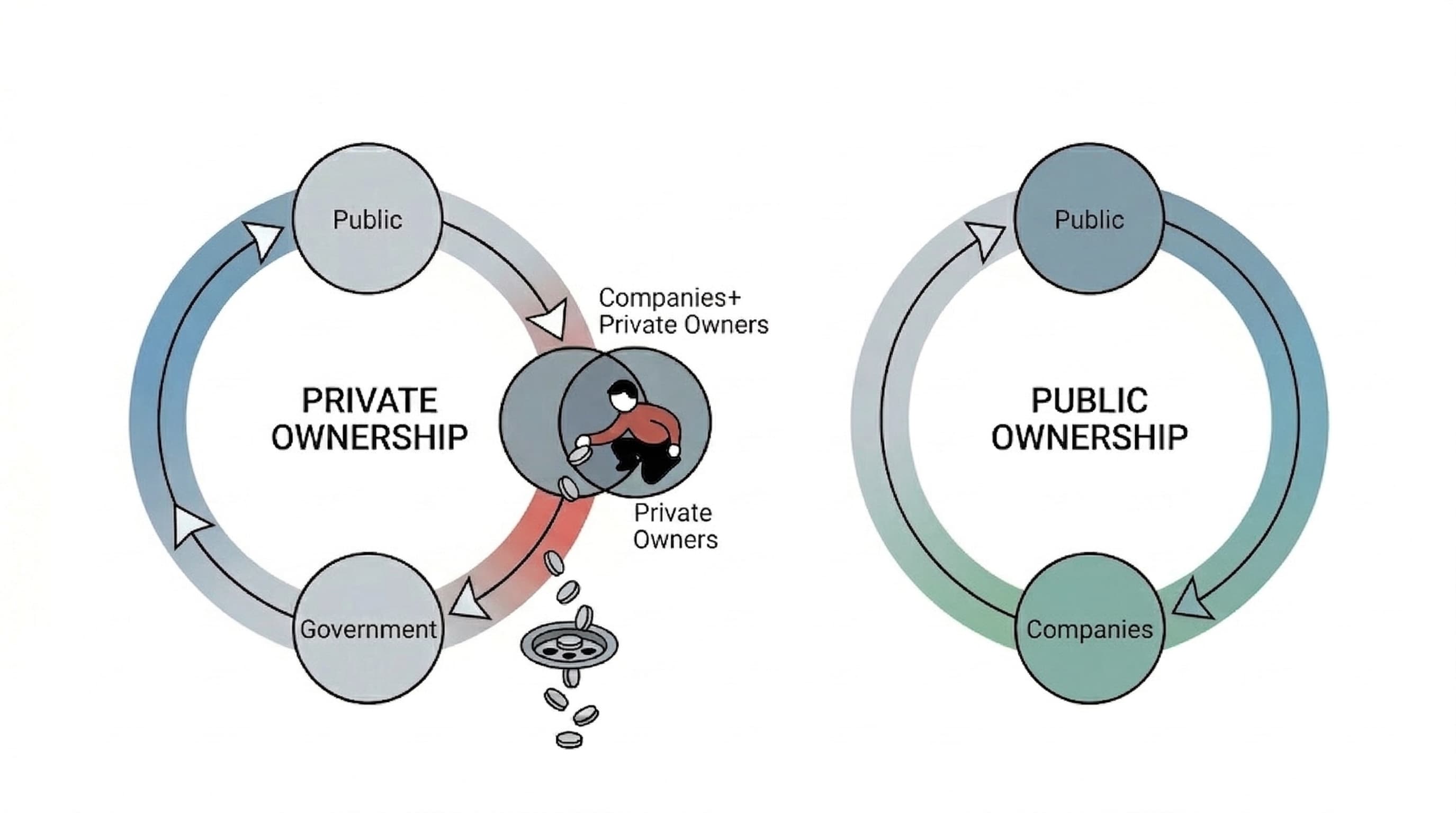
In Part 3, I showed why UBI under private ownership is a logical impossibility. Every dollar the government gives to displaced workers leaks out as private profit. The only way to stop the leak is to tax profits at 100%. At which point you've ended capitalism anyway. You just took the longest, most painful and absurd path to get there.
So where does this actually end?
The arithmetic only works one way
Here's the core problem one more time, as simply as I can state it.
Capitalism distributes goods through paychecks. AI eliminates the paychecks. Without paychecks, people can't buy things. Without buyers, businesses can't sell things. The system that produces everything for everyone can't get any of it to anyone.
UBI tries to solve this by taxing the producers and giving the money to consumers. But the producers take a cut every cycle, so the money slowly drains out. The government has to keep printing more. The math doesn't work.
There's exactly one arrangement where the math does work: when the public owns the productive capacity directly. Not taxing private companies to write UBI checks. Owning the machines. Owning the output. Distributing it directly.
Under public ownership, there is no profit leak, because there is no private owner siphoning off a cut. The public produces the goods. The public gets the goods. Money, to the extent you even need it, circulates from the public back to the public. The impossible arithmetic from Part 3 becomes trivially solvable. Not because of some clever policy design. Because the structural problem has been removed.
Think about GPS. The US government spent billions building and maintaining GPS satellites. Every person on Earth uses the system for free. Nobody pays per query. Nobody pays a subscription. We own the infrastructure, so we get the benefit. No profit leak. No need for a tax scheme to redistribute the value. It just works.
Now extend that principle to the rest of the economy.
We already do this
The same arrangement holds for everything from roads and bridges to public health and pure scientific research. A huge chunk of our economy already is publicly owned and works great, despite having been under constant attack and subject to constant cuts for decades.
Roads. You drive from New York to Los Angeles on the interstate highway system and you don't get a bill for each mile. The public built it, the public maintains it, the public uses it. It was not built by private companies competing in a free market. It was built by the federal government because Eisenhower decided the country needed it.
Public schools. You send your kids to school and you don't get a tuition bill. And in communities that are not beset by high levels of poverty and inequality, the U.S. boasts the best public schools in the world, available to every child.
Libraries. Fire departments. National parks. Weather forecasting. The internet itself, which started as a Defense Department project and became the infrastructure of modern life.
At various points in history, we decided that certain things were too important to leave to the market. That they should be produced for use, not for profit. Or the market simply wasn't brave and bold enough to create them. And they work. The US Post Office delivers to every address in the country for the same price. FedEx and UPS won't touch rural routes without subsidies. Public utilities, which make up the vast majority of our 3,000+ utility companies in the United States, deliver electricity to everyone at a much lower cost and with much greater reliability on average than private utilities.
This pattern is so familiar we don't even see it. You drive on a public road to a public library past a public school protected by a public fire department, and none of it feels radical. It feels normal.
This proposal is extending that principle to most of the rest of the economy. And the reason to do this soon, which will not be a matter of ideological preference. We will have to do it because the only other alternative will be total economic collapse. And the decision point is going to come over the next several years, falling squarely on the shoulders of the next president of the United States.
Public ownership is not central planning
People usually object at this point. Planned economies don't work. The Soviet Union tried this and it collapsed.
The Soviet Union didn't fail because public ownership is inherently flawed. It failed because one central bureaucracy controlled everything. One set of planners decided what every factory produced, how much of it, and where it went. When that bureaucracy failed, the whole system failed.
Public ownership doesn't require that. In fact, a publicly owned economy could be far more decentralized, dynamic, and competitive than our current capitalist economy is. Imagine hundreds of publicly owned companies competing in every industry, constantly innovating, not competing to the death the way capitalist firms do, where one or a few winners take all and the losers are wiped out, but competing the way teams compete in a sports league: hard, real competition that drives excellence, but within a structure designed to keep all the teams playing and where innovations are quickly disseminated to all the players.
The difference from capitalism isn't less competition. It's that the profits flow back to the public instead of to private shareholders, and we can produce what we actually need without the financial bubbles, bailouts, and games with monopoly money that capitalism requires to keep the loop going.
We've already solved the planning problem
Another standard argument against planned economies is that no group of humans can track and coordinate the production and distribution of millions of products across an entire economy. Central planners in the Soviet Union tried to do this with spreadsheets and committees. They couldn't. The information problem was real.
But we solved that problem long before AI came along.
Amazon's logistics operation is larger than the entire Soviet consumer economy was. It tracks hundreds of millions of products across a global network of warehouses, predicts demand, routes shipments, and manages inventory in real time. Walmart's supply chain does the same thing, coordinating every product from factory to shelf across thousands of stores. These are not free markets. They are centrally planned systems run by software, and they work extraordinarily well.
Every major corporation in the world runs on this kind of planning. The "free market" is really a collection of giant planned systems competing with each other. The question was never whether planning works. The question is what outcomes are we planning for.
AI is making planning even easier and better. And it makes it available to every company, not just the giants who can afford massive logistics and technology teams. And in a publicly owned economy, where corporations compete and cooperate rather than trying to destroy each other, planning can happen across companies and across industries. Competing firms could share supply chain data, coordinate production to avoid waste, and adjust to demand shifts together, because they're all working toward the same outcome: a better overall life for the public. The result would be a level of economic efficiency we can't even imagine today, because capitalism's zero-sum competition actively prevents it.
And there's a deeper point. The story that free markets built the world's wealthy nations is largely a myth. Every wealthy country got rich through planned industrial policy, protectionism, and strategic government investment. After these countries got rich through government direction, they turned around and told poor countries to use free markets, And drilled the free market ideology deep into our minds. The economist Ha-Joon Chang calls this "kicking away the ladder."
What this actually looks like
So far I've been arguing that public ownership is where the math leads. Let me describe what that means in practice, because it's less exotic than it sounds.
You wake up. The power is on, generated by a publicly owned utility, same as it already is for the majority of Americans served by public power companies. Your water is clean. Your roads are plowed. None of this required you to negotiate with a private provider. You didn't even think about it. Your kids go to school, already public.
Now extend that to the workerless industries providing services and goods in the AI economy.
Remember, this transition won't come through expropriation. It will come in the context of capitalist firms and entire industries going out of business — no customers, no revenue, business models made obsolete by a networked AI in the hands, ears, and eyes of every consumer.
We can't predict exactly what shape this new economy will take. But let's imagine a few examples.
Say drivers still need auto insurance. Maybe the incumbent insurance companies have collapsed because all the safe drivers joined AI-organized risk pools that undercut them. Those pools were probably created by tinkerers or small startups who ran circles around the old companies, saddled as they were with bureaucracy, paperwork, and employees they weren't letting go fast enough. If a teenager, or a teenager's bot, can create a new auto insurance company with AI, so can the government. With AI, the days of the healthcare.gov debacle are long gone. The cheapest possible auto insurance can be made available to everyone by publicly owned, publicly accountable companies created with AI. Since AI will be in your phone, in your car, probably in your glasses, whenever an accident happens, no investigation will be necessary. The bills just get paid.
Or jump to an entirely different sector. Without paying customers, the streaming services and their attached movie studios go out of business. The United States is one of the only industrialized nations in the world without a state broadcaster. We could change that by creating dozens or hundreds of publicly owned media companies. Maybe it will turn out that nobody wants to watch real humans perform anymore. Maybe AI will just be better. Or maybe we will want to know that the characters we're getting attached to are played by real people. Whether it's a purely AI-generated entertainment industry or one that keeps millions of performers employed, this is something the public can simply provide for itself for free.
And what about AI itself? The big AI companies are going to go out of business unless they develop some kind of unique product they can monopolize. Right now, it doesn't look good for them. Thousands of independent and open-source Chinese (and a few American) models are already performing at levels very close to the top. As I explained earlier in this series, more raw intelligence is not even the highest priority when it comes to making AI useful. What matters is the harness around the AI that redirects raw intelligence into productive work, and that harness is being built primarily by tinkerers, open-source developers, and small startups.
When the big AI companies go bankrupt, someone needs to buy up their models and data centers, keep the servers running, and keep the AI flowing, but now as a public utility. If AI were not the death of capitalism, all of this capacity would be bought for pennies on the dollar by private equity or dinosaur telecom companies, the way the internet was after the dot-com bust. But AI is going to be the death of capitalism. So it will be up to us, the public, to keep AI flowing from the spigots.
And it will be far, far better this way. Instead of going through a long period of consolidation into the hands of a few oligopolistic utility providers, we can choose, as the public, to keep our foot on the gas of growth and innovation. AI and automation can keep powering ahead, making our lives easier, making our work days and work lives shorter, and creating virtually unlimited good things that we, the public, choose to create. How about that cure for cancer that all of our AI companies were supposedly founded to discover before they got distracted by erotic chatbots and AI slop video?
How far does public ownership need to go?
Perhaps this is how the transition happens. Maybe there's no one moment when everything needs to switch over. Instead, the public rescues company after company, industry after industry, as the lights go out on capitalism from one sector to the next.
It's impossible to predict how the sectors that haven't been automated will fare through this transition. Maybe there is a gradual path where some industries convert to public ownership while others keep operating under the old model. But it's hard to see one.
Here's the problem. If AI-automated services are being provided to laid-off workers essentially for free, it's hard to see how workers in the remaining private-sector industries keep showing up. Why would you grind away at a factory job when everyone around you is getting their services from public enterprises at no cost? The old economy can't function alongside the new one. The logic of capitalism breaks down across the board.
More likely, virtually all major corporations will need to be rescued through conversion to public enterprises. Not because of ideology, but because without customers, without revenue, without profits, they have no reason to exist in their current form.
The point is not to seize every business in America. Millions of small businesses and many larger ones can keep operating under private ownership as long as they can stay in business. But the economy will need to transition to a system where everyone who can work does enough work to produce the living we all want as a society, and that living is distributed to all.
Note, however, that converting a company into a public enterprise doesn't mean its owners lose control over it. Imagine a small or medium-sized manufacturing firm that produces valuable equipment the whole economy depends on. The turbulent death of capitalism by AI makes it impossible for the firm to function as a private company. When it gets rescued through conversion into a public corporation, the owners and managers can remain in control. In fact, this process will be almost identical to the process of taking a company "public" in the capitalist sense, selling shares and giving up most ownership to public markets. Just as founders often make a killing when their company goes public on private markets, these owners and managers could be handsomely compensated. If that's what we, meaning the public, decided should happen.
And the most likely way this happens is not through expropriation. It's through bailouts.
When the AI bubble bursts, and it will burst, some of the biggest companies in the country are going to find themselves insolvent. The big AI companies have taken on massive debt building data centers and training models. If it turns out there's no real barrier to entry, that teenagers with expensive computers can compete with them on foundation models, those companies can't pay their debts. They go bankrupt. The government steps in, the way it always does, but instead of handing over cash and hoping for the best, it pulls them out of bankruptcy by converting them into not-for-profit public enterprises. The companies stay whole. The workers keep their jobs. The technology keeps running. The debt gets restructured. The only thing that changes is who benefits from the output.
The same thing will happen to banks. If the AI bubble takes down the financial sector the way mortgage-backed securities did in 2008, the big banks will wake up insolvent again. This time, instead of bailing them out and letting them go right back to the same behavior, we convert them into not-for-profit public utilities. They keep serving as sources of credit, keeping the economy innovative and agile. They just stop extracting profit for shareholders.
None of this requires converting the entire economy. Millions of small businesses, medium-sized companies, and big corporations can keep operating exactly as they do now, as long as their business models still make sense. A restaurant, a construction firm, a local manufacturer, these can all keep running under private ownership. The question is what happens when AI liquidates entire industries. And there, we get to make choices as a society. When advertising and marketing are put out of business by AI, I hope we decide we don't need them back. Publicly owned corporations will never need to advertise, because the public does not have the goal of making itself want things it doesn't actually want.
What about work?
Will people still work? Yes. We have enormous amounts of work to do.
When we at New Consensus put out the Green New Deal, every economist we talked to said the same thing: the main obstacle is that there wouldn't be enough workers. The economy would overheat if the government tried to pull millions of people out of their current jobs and into new jobs building the new economy. It would cause inflation, shortages, and chaos. In response, we developed plans to bring millions of people back into the workforce to make big projects possible, even if the labor market stayed tight.
In the context of mass AI layoffs, finding workers is not going to be a problem. For the first time, we will have what we need to build the industries and infrastructure required to survive and thrive in the 21st century. We can fix our crumbling public infrastructure. Harden our cities and coastlines and rural communities against flooding, storms, and extreme heat. Build the clean energy systems and supply chains we need to stop changing the composition of the atmosphere into something that is radically heating the planet.
The question is how we organize the work. And this is not a question we can productively speculate on in detail, because even if this moment comes in just a few years, the world will be so different that the possibilities are impossible to predict from today.
But imagine one version. With radically less labor needed to produce what we currently produce, and with AI handling the cognitive work that used to require entire departments of professionals, people might work a few hours a day. Or a few days a week. Or a few months out of the year. And everything still gets done, and everybody makes a good living.
That's no longer a utopian fantasy. That's now a possible practical consequence of an economy where machines do most of the production and humans do what humans are actually good at: raising families, helping others in their communities, building relationships, being creative, and doing the physical and social work that gives life meaning. For the first time in history, human beings could stop trying to do the work of machines and computers, and go back to being fully human again.
This will not be easy
Everything I've said so far makes public ownership sound clean. Elegant, even. The arithmetic works, we already do it with roads, AI makes coordination feasible. All true. But the transition from here to there will be one of the most difficult political and social challenges any society has ever faced. And the outcome, depending on who wins the political fights along the way, could be deeply unfair.
The hardest questions are distributional. Who gets how much? In a capitalist economy, the market answers that question, badly and often cruelly, but it answers it. In a publicly owned economy, people have to answer it. Politics has to answer it. And the history of politicians deciding who gets what is not exactly inspiring.
Think about what has to be negotiated. Does a surgeon get more than a janitor? How much more? Does a family with four children get a larger house than a single person? Who decides what gets produced? If AI can make anything, who chooses between more housing and more parks? Between cancer research and space exploration? Between high-speed rail and rural broadband?
These are real questions, and they don't have obvious answers. Every one of them will be fought over. Every one of them is an opportunity for corruption, for patronage, for the powerful to rig the system in their favor. Public ownership does not automatically mean fair ownership. It means the public deliberates about ownership instead of the market deciding by default.
Look at how public resources are distributed right now. Public schools in wealthy neighborhoods get better funding than public schools in poor neighborhoods. Infrastructure investment flows to politically connected districts. Medicare covers the elderly but not everyone. Every piece of public ownership we have is shaped by the politics that created it, and American politics is not famous for producing fair outcomes.
A publicly owned AI economy could end up looking like Star Trek: shared prosperity and high quality of life for everyone. Or it could end up looking like a company town: a small group of political insiders controlling the machines, allocating resources to their allies, and leaving everyone else to fight over scraps. The arithmetic works in both cases. The question is whether the politics produce something worth living in.
But here is what I can tell you: these are political questions, not structural impossibilities. The math problem from Part 3, where profit leakage drains every UBI system to zero, has no solution under capitalism. It's broken by design. The distributional fights of a publicly owned economy are hard, but they're the kind of hard that politics exists to solve. We've solved them before, imperfectly, for schools and roads and Social Security. We can solve them again. Hopefully a bit more perfectly this time.
The fight
Every piece of public infrastructure we have was fought for by people who decided that certain things were too important to leave to the market. Roads didn't just happen. People demanded them. Public schools didn't just appear. Communities organized and built them. Social Security exists because millions of elderly Americans were dying in poverty and people demanded that it stop.
None of this was given. All of it was demanded. And in every case, the people who profited from the old arrangement fought against the change. The railroad barons didn't want public roads. Private schools lobbied against public education. Insurance companies fought Medicare for decades.
Public ownership of AI-driven productive capacity will follow the same pattern. And the outcome will depend entirely on who shows up for the fight. If the only people at the table are tech billionaires and their lobbyists, we'll get a version of public ownership that serves them. If working people organize and demand a say, we might get something that actually works for everyone.
I don't know exactly what the publicly owned economy will look like. Nobody does. The distributional fights will be ugly. Powerful people will try to rig the outcome. The transition will be messy and painful and imperfect.
But I also know that a privately owned capitalist economy without workers cannot exist. That's not an opinion. That's arithmetic. And the arithmetic doesn't care about our preferences.
The only question is whether we start building the alternative now, while our institutions still function, or whether we wait until the collapse forces us to build it from the rubble.
That part is up to us.