Who Bombs?
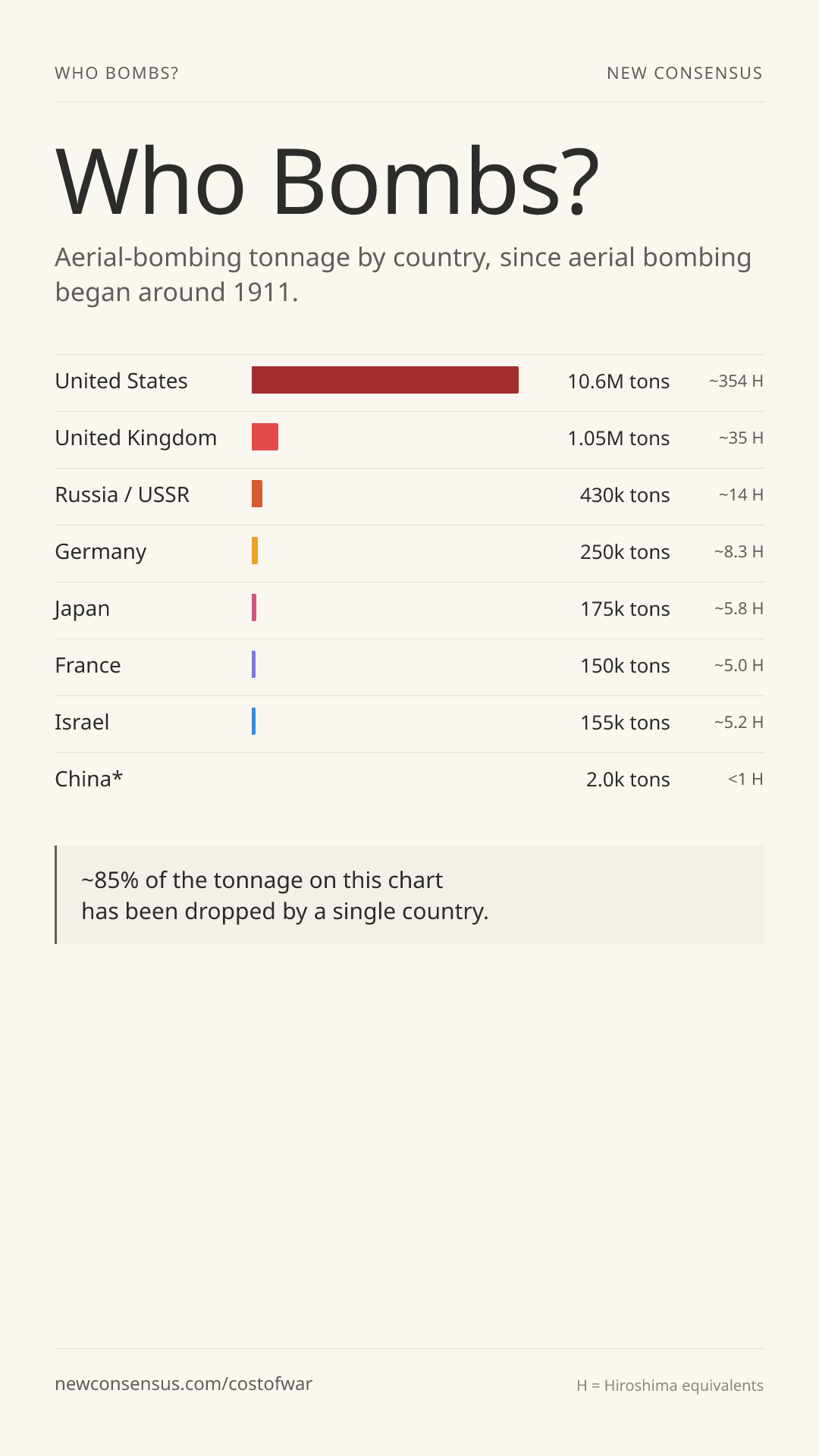
Estimated tonnage of bombs and missiles dropped in war, by country, since aerial bombing began around 1911.
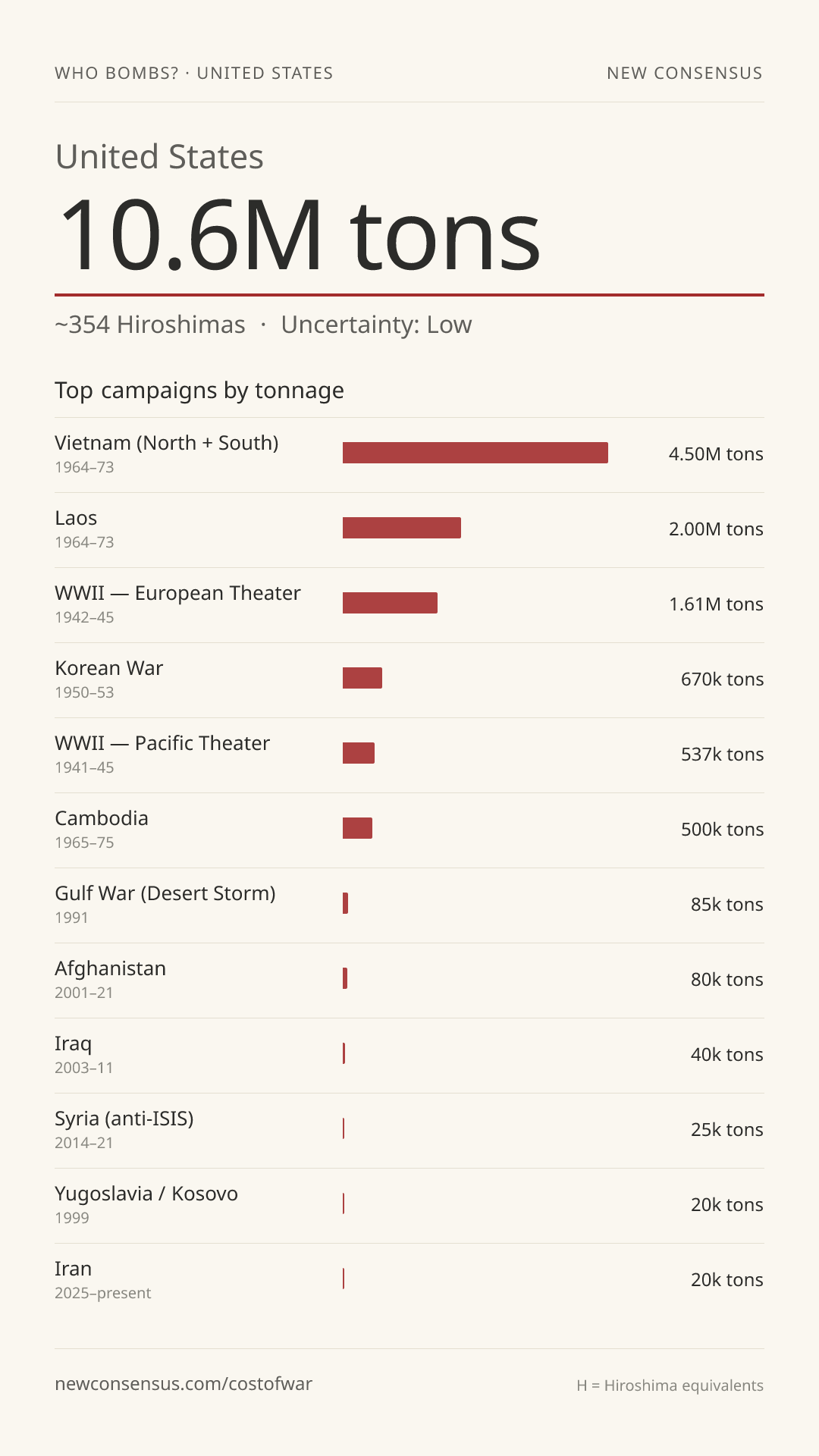
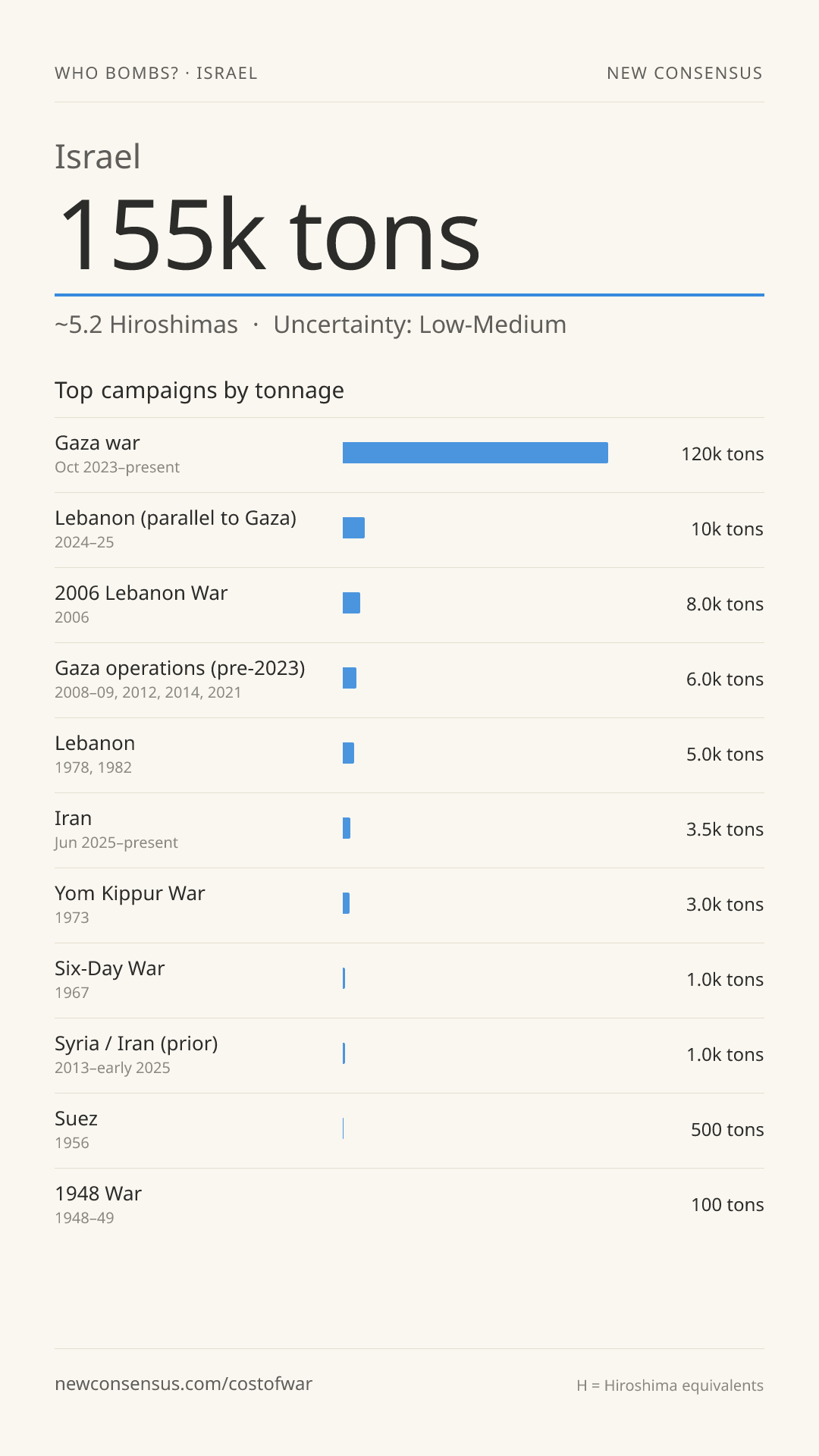
Click any bar to see the war-by-war breakdown. All figures are rough estimates; uncertainty is flagged per country. How we count →
Total aerial-bombing tonnage by country, since ~1911
* China: ~2,000 t total, almost all before 1949. The People's Republic has conducted effectively no aerial bombing in 75 years.
Also worth noting
Not on the main chart, either because of data gaps or because the totals are smaller than the eight countries above.
- Saudi Arabia + coalition in Yemen~20,000–40,000Destructive but poorly documented.
- Iran~17,000Iran's share of the Iran–Iraq War (~15,000 t of the ~30,000 t combined), plus the 2024 True Promise I (April) and II (October) ballistic-missile and drone barrages on Israel, and 2025–26 strikes on Israel and US bases in the Gulf during the Iran war — 5,400+ drone/missile attacks on Arab countries in March 2026 alone. Warheads range from 500–750 kg (Shahab-3, Kheibar Shekan, Emad) to ~50 kg on Shahed-136 drones.
- Iraq (Iran–Iraq War)~15,000Iraq's share of the ~30,000 t combined Iran–Iraq aerial war, including chemical-weapons use.
- Italy (WWII + Ethiopia)~30,000Ethiopia campaign used chemical weapons (mustard gas).
- Syria (Assad regime)hard to tonnageBarrel bombs in the civil war. Very large in volume.
- TurkeymoderatePKK strikes in Iraq and Syria.
- India / PakistansmallBrief conflicts; Kargil and Balakot were limited.
Social assets
1080×1920 portrait PNGs for Instagram, TikTok, Reels, and Stories. Tap Share image on mobile to hand the PNG straight to X, Instagram, Threads, WhatsApp, or any other app via the OS share sheet. On desktop, Share image copies the PNG to your clipboard — paste into the X compose box. Download always works.
Methodology & sources
What's counted
“Bombs and missiles” here means aerial-delivered munitions: bombs, cruise missiles, ballistic missiles, and air-launched rockets and drones. It does not include artillery shells, naval gunfire, or ground-launched rockets / MLRS — which would substantially increase Russia's, Ukraine's, and China's (Korea) totals.
The Hiroshima math
Conventional bombs are not pure TNT. A typical bomb is ~40–50% explosive by weight, and modern fills (RDX, Composition B) are ~1.15× as potent as TNT per kilogram. Netted out:
1 ton of bombs ≈ 0.5 tons of TNT equivalent.
Hiroshima ≈ 15,000 tons TNT.
So Hiroshimas = (bomb tonnage × 0.5) ÷ 15,000.
Caveat. “Hiroshima equivalent” compares explosive energy, not destruction. Hiroshima released its energy in microseconds from a single 600 m point burst. Conventional bombing spreads comparable energy over years and large areas. 350 Hiroshimas of conventional tonnage does not equal 350 nuclear weapons of destruction.
Uncertainty
- United StatesLow~85% of all tonnage on this chart. THOR database is the main primary source for WWII and Vietnam.
- United KingdomLowBomber Command's 1940–45 offensive accounts for ~94% of the UK total.
- Russia / USSRHighHigh uncertainty. The Soviet-Afghan War, both Chechen wars, and the ongoing war in Ukraine are the least-well-documented campaigns in this dataset. The real total could plausibly be 2× this figure.
- GermanyMediumAlmost entirely 1936–45. Post-war Germany (both East and West, and reunified) has not conducted offensive aerial bombing.
- JapanMediumAlmost entirely 1932–45. Article 9 of the postwar constitution forbids offensive military action, and Japan has conducted no aerial bombing since 1945.
- FranceMedium-HighColonial and postcolonial operations are the largest share. Metropolitan figures for Indochina and Algeria vary considerably by source.
- IsraelLow-Medium~85% of Israel's all-time tonnage has been dropped since October 2023. The Gaza figure is an estimate based on IDF strike counts and Euro-Med / UN reporting; it may still move.
- China*LowAlmost all Chinese aerial-bombing tonnage is pre-1949. The People's Republic has conducted effectively no strategic aerial bombing in 75 years. Chinese MiG-15 pilots fought in Korea in air-to-air combat, but dropped no bombs.
Known gaps
- Pre-WWII colonial bombing. British, French, Italian, and Spanish colonial air policing (Iraq, Somaliland, Rif, Libya, Ethiopia) is only partially captured.
- Barrel bombs in Syria. Assad-regime barrel bombing was massive in volume but hard to convert to tonnage reliably; it is not in this dataset.
- Russian Ukraine data. The 2022–present war is poorly documented in open sources; the figure here will move.
- Chemical weapons. Italy in Ethiopia, France in Morocco, Japan in China, and Iraq against Iran / Kurds used chemical fills. These are counted by bomb tonnage, not by chemical impact.
- Cambodia. The widely-cited 2006 Kiernan & Owen figure of ~2.7 million tons was revised downward by the authors themselves in 2010 after identifying a calculation error. Their corrected position: ~500,000 t is the undisputed figure for 1969–73. The chart uses 500,000 t accordingly. Older sources still circulating the 2.7 M number are working from the retracted estimate.
- Sub-war figures are rough. The war-by-war numbers in each country's drill-down are independent estimates; they will not always sum exactly to the stated country total. Where they differ noticeably (e.g. France), the country total is taken as authoritative and the sub-war figures as illustrative.
Sources
- Strategic bombing during World War II — Britannica
- Strategic bombing during World War II — Wikipedia
- Making More Enemies than We Kill? Calculating U.S. Bomb Tonnages Dropped on Laos and Cambodia — Kiernan & Owen, Asia-Pacific Journal: Japan Focus, 2015
- The Long Run Impact of Bombing Vietnam — Miguel & Roland, Berkeley working paper
- Gulf War air campaign — Wikipedia
- Hey, Hey, USA! How Many Bombs Did You Drop Today? — Davies & Benjamin, The Progressive, Jan 2022
- Euro-Med Human Rights Monitor — Gaza reports — 2023–2025
- UN Fourth Committee Report A/79/363 (2024) — United Nations
- Bombing of Chongqing — Wikipedia
- THOR: Theater History of Operations Reports — Defense Digital Service (US DoD)
- Israeli bombing of the Gaza Strip — Wikipedia
- 2025 United States strikes on Iranian nuclear sites (Operation Midnight Hammer) — Wikipedia
- The weapons of Operation Midnight Hammer: MOPs, Tomahawks, and more — Air & Space Forces Magazine, June 2025
- Over 5,000 munitions shot in the first 96 hours of the Iran war — Foreign Policy Research Institute, March 2026
- Operations Epic Fury and Roaring Lion — JINSA, March 2026
- Timeline of the 2026 Iran war — Wikipedia
- Rising Lion's air offensive — FPRI, March 2026
- Iran launched over 5,400 attacks on US bases and critical sites in Arab countries in a month — Anadolu Agency, 2026
“Hiroshima equivalent” measures integrated explosive energy, not integrated destruction. Hiroshima released its energy in microseconds from a single point; conventional bombing spreads comparable energy over years and wide areas.